Agentics Beyond Code
What happens when you give PMs, compliance teams, and leaders their own agents? A tour of Agentics Beyond Code — an open-source set of GitHub Agentic Workflows for the non-engineering roles that ship, govern, and operate products.

What happens when you give PMs, compliance teams, and leaders their own agents?
Most of the conversation around agents in software development focuses on code — writing it, reviewing it, testing it. But the work of shipping software extends far beyond the editor. Product managers track launches. Compliance teams review security and privacy posture. Leaders need status rollups that don’t require chasing people down on Slack every Friday.
What if that work could be agentic too?
Agentics Beyond Code is an open-source project that brings GitHub Agentic Workflows to the non-engineering roles that ship, govern, and operate products. It’s a collection of ready-to-use workflows — plus the design patterns behind them — that turn a GitHub repository into an operational nervous system for an entire team.
A simple example: launch tracking
The simplest version is this: a workflow reads normal GitHub data and writes back a useful Markdown artifact.
A launch readiness workflow turns this:
- Open launch issues
- Child epics and tasks
- Project fields like phase and target date
- Labels like
ai:needs:securityandapproved:privacy - A Markdown policy file that defines what “ready” means
Into this:
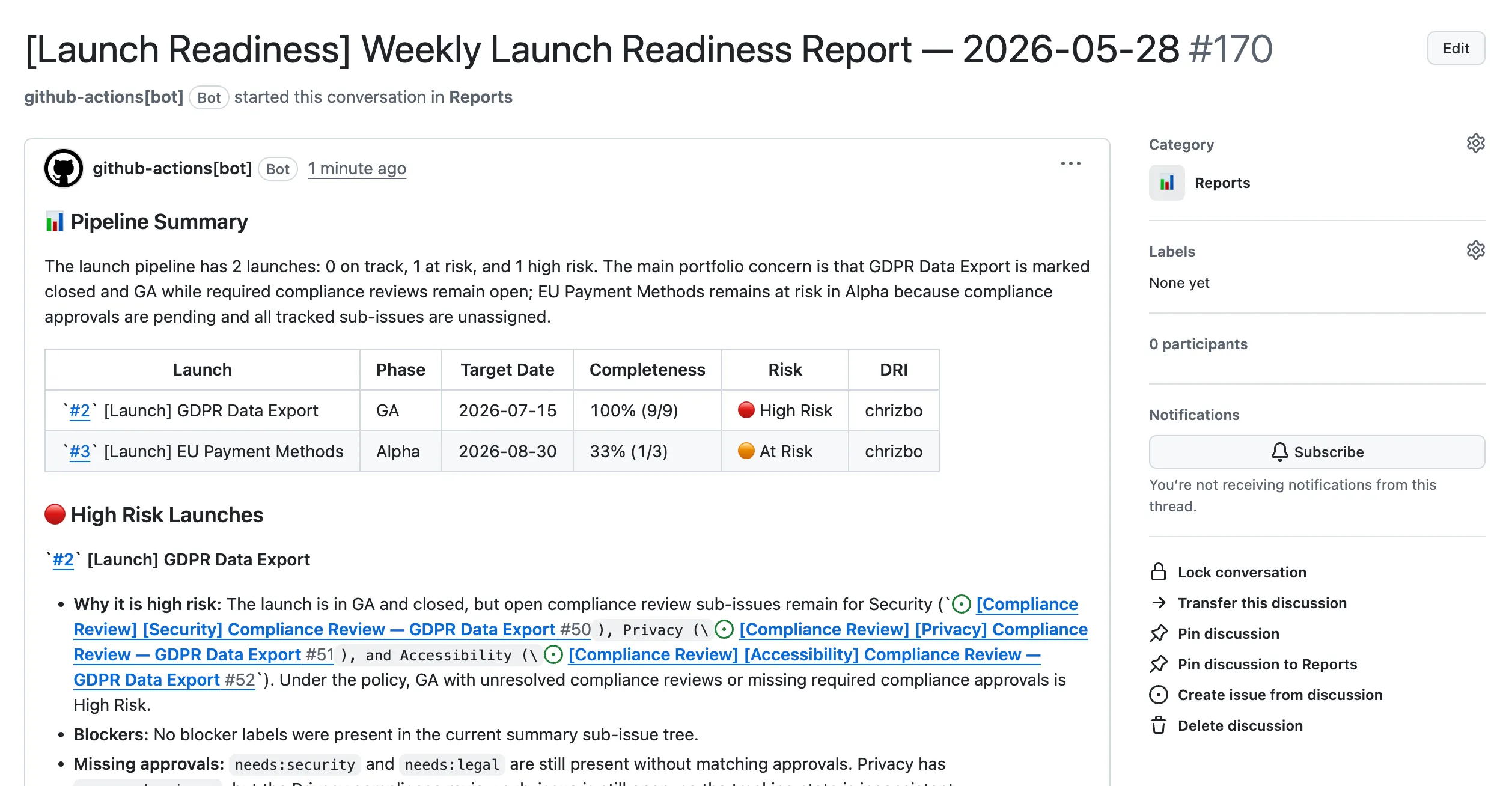
See the full sample report in the Agentics Beyond Code repo.
That is the core pattern: GitHub data in, policy-guided judgment applied, Markdown artifact out. The system looks bigger because the repo includes many examples, but each workflow is just a small loop around one bounded artifact.
Under the hood, the launch readiness workflow is mostly a Markdown instruction file:
## Process

1. Load `launch-data-summary.json`
2. Analyze the sub-issue hierarchy
3. Assess launch quality
4. Assign risk levels
5. Generate the report
And the team’s standards are also Markdown:
| Phase | Expected Completeness | Risk if Below |
|-------|----------------------|---------------|
| Alpha | >= 30%               | Medium        |
| Beta  | >= 70%               | High          |
| GA    | >= 95%               | Critical      |
The reusable shape is deliberately plain:
- Fetch structured repo data with a deterministic script
- Give the agent clean JSON plus a policy file
- Ask it to produce one bounded artifact
- Post that artifact back to GitHub through a constrained safe output
The trust boundary is explicit. The launch readiness workflow can read repository content, issues, pull requests, and discussions, but its only configured write is one report discussion:
permissions:
  contents: read
  issues: read
  pull-requests: read
  discussions: read

network:
  allowed: [defaults, github]

safe-outputs:
  mentions: false
  allowed-github-references: []
  create-discussion:
    title-prefix: "[Launch Readiness] "
    category: "reports"
    max: 1
That matters. The workflow is not free to wander around the repo creating issues, assigning people, editing code, or tagging teammates. It gets a narrow output lane: create at most one Discussion in the reports category, with mentions disabled.
For most teams, the first useful version is just a scheduled Markdown report.
The idea: animate the artifact, not the job title
The temptation with agentic automation is to think in terms of roles: “build me a PM agent” or “automate the compliance officer.” Agentics Beyond Code takes a different approach. Each workflow is scoped to the artifact it produces — a readiness report, a decision record, a compliance status table — not the person it replaces.
This turns out to matter a lot. When you scope to an artifact, the workflow has natural boundaries. The agent knows what it’s supposed to produce, what inputs it needs, and what “done” looks like. It also matches the GitHub Agentic Workflows framing: agents are tools, and tools create artifacts. Nobody argues about whether an agent should attend standup.
What’s in the box
The repo ships with 16 workflows across seven categories, but you do not need to adopt them all. Pick the artifacts your team already relies on, then start with the workflows that produce those artifacts.
Intake & Triage. Intake Request Triage scores incoming feature requests and bug reports using RICE and Kano frameworks. When someone files an issue via the intake template, the agent reads the team’s strategy doc, checks for duplicates, flags incomplete submissions, evaluates strategic alignment, and adds the item to the triage project board. The PM still makes the call; the agent does the homework.
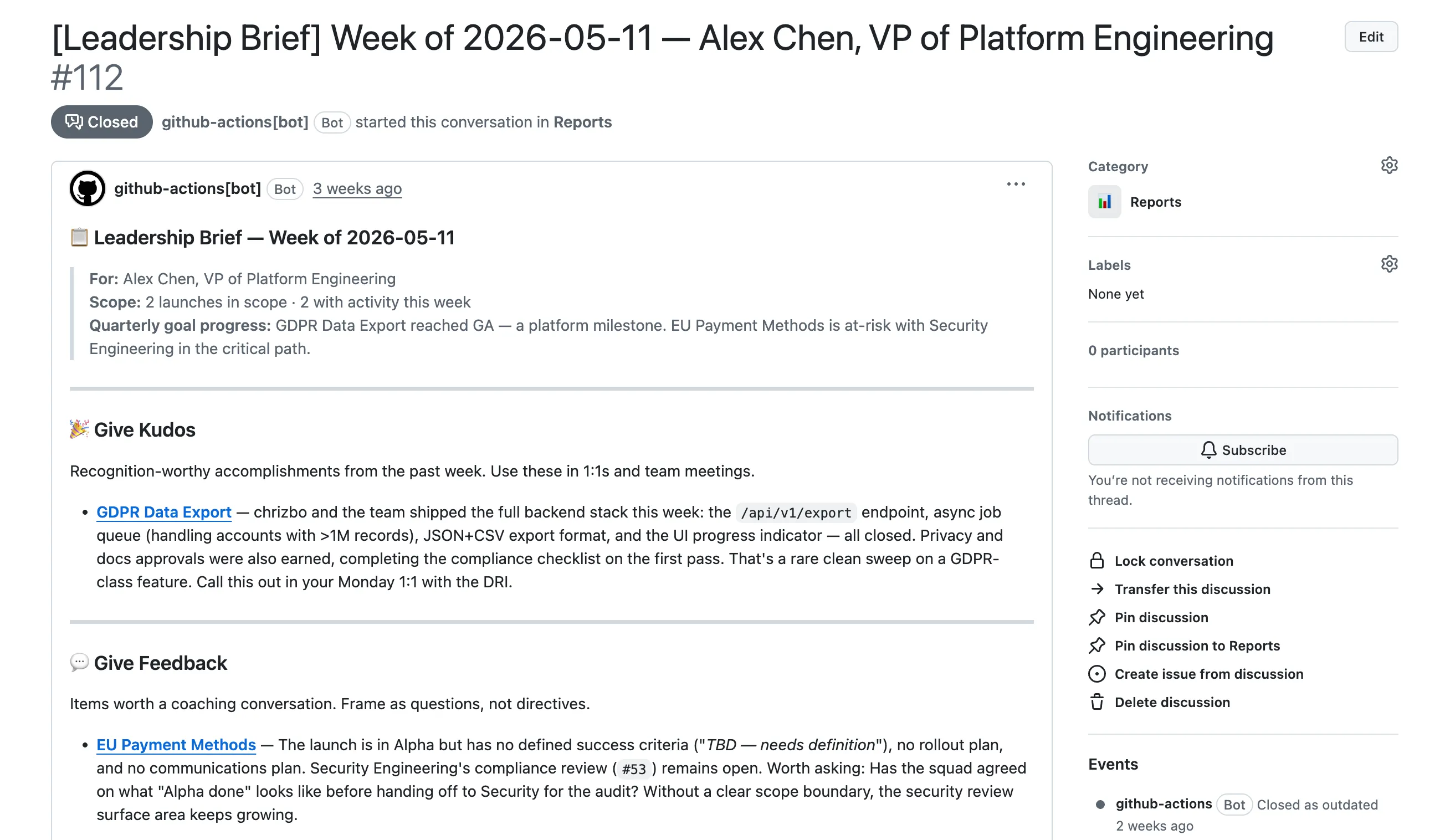
Weekly Status. Weekly Status is the broad portfolio artifact: What Shipped, What We Learned, FYI, and SOS. It gives leaders a fast read across initiatives and launches without turning every update into a meeting; Leadership Briefs use the same data to create tailored action notes for each leader.
Decision Log. Decision Log turns messy comments and transcripts into durable Markdown decision records in /decisions/. This is where the system starts to compound: once decisions exist as artifacts, other workflows can reason over them.
Strategy Alignment. Strategy Alignment compares weekly decisions and activity against the team’s stated strategic tradeoffs. It annotates the strategy doc with evidence of alignment and flags issues that appear to pull against the strategy.
Adversarial PM. Adversarial PM picks the 2–3 most consequential decisions each week and posts specific counterarguments on the source issues. It argues from non-deterministic lenses like pre-mortem, opportunity cost, “who loses?”, and reversibility. The philosophy: the most dangerous decisions are the ones nobody argues against.
Process Analyzer. Process Analyzer runs weekly retros, detects process drift against how-we-work.md, identifies automation opportunities, and opens PRs to keep operating docs current.
There is more in the repo — launch readiness, compliance reviews, GTM content, transcript processing, workflow health, standup prep, and sample data generation — but the point is not to install every workflow. The point is to pick a high-value artifact and give it a focused agentic tool.
Design patterns worth stealing
Even if you don’t adopt these specific workflows, the design patterns are reusable:
Process as Code
Team policies — “what does launch-ready mean?”, “what’s our security review rubric?” — live as markdown files in .github/policies/. The agent reads them at runtime. When you update the policy, you change the workflow’s behavior. No redeployment, no config drift, no “the wiki says one thing but we actually do another.” The leadership briefs take this furthest: each leader gets their own policy file defining their scope, goals, and what signals matter to them — so a single workflow produces completely different briefs for each person.
Safe outputs
The workflows also separate analysis from action. The agent can reason over the data, but it can only act through the safe outputs declared in the workflow file. For launch readiness, that means one Discussion report and nothing else. For compliance workflows, the safe outputs allow the specific artifacts those workflows need, such as review sub-issues or team reports. The permission model is part of the design pattern: make the artifact useful, then constrain the workflow to that artifact.
Deterministic pre-steps, agentic analysis
Agents are great at reasoning but unreliable at paginating through GraphQL APIs. So a deterministic bash script fetches all project data, resolves custom fields, and walks sub-issue trees. It outputs clean JSON. The agent consumes that JSON and does what it’s good at: analysis, scoring, and report generation.
This “script for data, agent for judgment” split is the single most reusable pattern in the project.
Living documents
Strategy docs and process guides go stale the moment someone merges a PR or wraps up a meeting. Agentics Beyond Code connects documents to the events that should update them. The Process Analyzer watches meeting transcripts for drift from how-we-work.md and opens PRs to keep it current. The Strategy Alignment workflow annotates strategy.md with evidence from actual decisions. The documents stay as current as the work itself.
The repo is the architecture
The model is interchangeable. What makes these workflows effective is the environment they operate in: issues, labels, sub-issue hierarchies, policy files, transcripts, decision records. Designing the repo topology well matters more than picking the right LLM. A well-structured repo gives any agent — today’s or next year’s — the context it needs to do useful work.
Try it yourself
The easiest path is the Non-Coder Agentic Workflow Builder skill. It helps you choose an artifact, install the matching workflow, wire up the required labels/projects/secrets, and customize the policy file without turning setup into a scavenger hunt.
The repo’s Getting Started guide covers the underlying prerequisites, setup, sample data, first runs, and policy customization in one place, so the instructions can keep improving without this post going stale.
The practical advice is simple: pick one artifact your team already needs, run the matching workflow, then edit the policy file and run it again. When the policy changes, the artifact changes. The policy is the configuration.
What we learned building this
A few things surprised us along the way:
Separating workflow from policy was the unlock. Early versions hardcoded team-specific rules into the workflow prompts. Extracting policies into standalone files made the workflows portable across teams and made policy changes feel like “editing a doc” rather than “modifying an automation.”
Event-driven workflows need activation guards. The intake triage workflow fires on issue label events — but so do other workflows. Without guards, an agent might waste a run processing an irrelevant event. Each event-driven workflow now checks preconditions upfront (right labels? not already triaged?) and calls a noop safe output to exit cleanly if the trigger doesn’t apply. Small detail, big cost savings.
Cost transparency matters. Every workflow report includes a token-usage footer showing input tokens, output tokens, and estimated cost. When people can see that a weekly readiness report costs ~$0.15, adoption resistance drops.
Compounding effects are real. The Decision Log creates records. The Strategy Alignment workflow reads those records and annotates the strategy doc. The Process Analyzer reads transcripts and updates the how-we-work doc. Each run leaves the repo a little smarter. After a few weeks, the repo accumulates a structured institutional memory that no wiki could match.
Where this is heading
Agentics Beyond Code is early-stage and opinionated. It assumes your team uses GitHub Issues and Projects. It assumes you’re willing to structure your repo as the system of record. But if that fits your workflow, the payoff is real: the routine operational work that eats PM and compliance bandwidth gets handled automatically, with full transparency, and the humans focus on judgment.
Want help implementing this for your team? Reach out to Chris Butler on LinkedIn, the creator of this project.