Post

Sparkle Pills
A flexible templating convention for contextual inference
A flexible templating convention for contextual inference

How far can documentation be compressed without losing its meaning?
WikiKB is an efficient, transparent, and explicitly curated knowledge base layer for humans and agents, built on the GitHub repository wiki.
Evergreen helps keep pull requests green and mergeable by fixing CI failures and merge conflicts, and keeping PR branches up to date with the base branch.
In 2022, we got better output from large language models by asking them to show their work. In 2026, can we get better output from autonomous agents by asking them to be proud of their work? The next time your agent says it’s done, ask it whether it’s proud of its work — and if not, to keep iterating until it is.
Agentic Workflows gives you complete control to customize your Actions runtime and choose your AI model. You can deploy Agentic Workflows to a custom runner of your choosing and use any compatible AI host or model-routing platform. You can even use local inference running on your Mac!
Turn an issue into an agentic mission

Crane is a migration assistant for GitHub repositories that plans, executes, and verifies code migrations in small agentic steps while keeping humans in control.
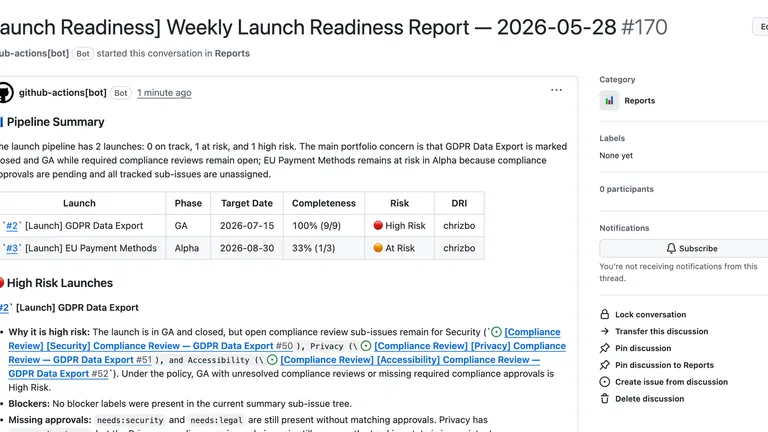

What happens when you give PMs, compliance teams, and leaders their own agents? A tour of Agentics Beyond Code — an open-source set of GitHub Agentic Workflows for the non-engineering roles that ship, govern, and operate products.


GitHub Agentic Workflows filter untrusted GitHub content before it reaches the agent. Here’s why integrity filtering matters for repository maintainers, and how we built it.

Prompts are programs. You wouldn’t write a complex program completely from scratch, in a big, soupy loop without subroutines, and then write it again the next time you wanted to run it. Why let your agent work that way?
Borrowed from 3D rendering: level of detail. The loader shows more as it grows and strips back as it shrinks, so it reads cleanly at any size.

Canary puts a small, auditable gate in front of agentic workflows so untrusted artifacts are classified before powerful agents act on them.
https://github.com/githubnext/repo-assist-impact/blob/main/report.md
What happens when a proactive AI repository agent is deployed across 13 open source repositories? 578 issues closed, median 8x increase in issue closure velocity, and 10x in PR merge velocity — transforming largely dormant projects into actively maintained ones. The single most important factor? The rate at which human maintainers decide to act.
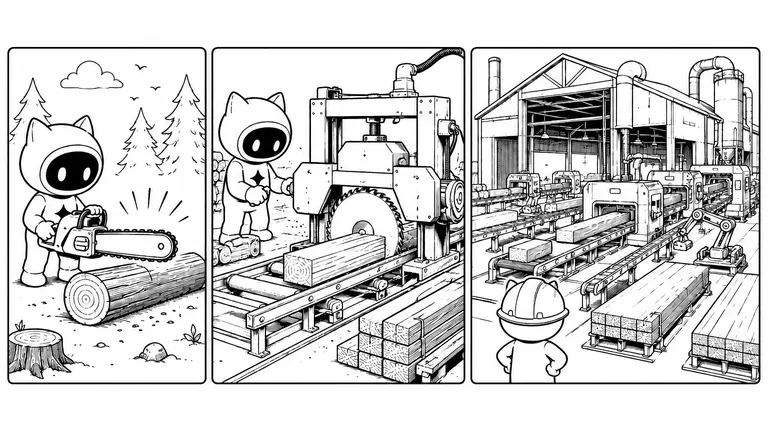
A practical mental model for agents, workflows, and human-machine systems in agentic engineering.
Agents can power robust workflows by intelligently reacting to unexpected conditions, creating a new form of flexible resilience.
https://dsyme.net/2026/05/05/understanding-repositories-as-human-agent-knowledge-factories-%f0%9f%9a%80/
How do you maintain team velocity when AI-generated code needs cleanup? You have two choices: slow everyone down with more review hurdles, or let automated agentic processes clean things up after the fact. The second path is the key to velocity — and it’s now practical with repository automation.
tsb is a from-scratch TypeScript port of pandas, being built almost entirely by Autoloop — one iterative improvement at a time.

Ok, it’s not really a new site. But it’s an important refresh!
Glossy finished products are fun, but the real meat is hiding in the sketchbooks. Makers love to see the raw ideas, the struggle to make it work, and the tradeoffs made in service to shipping. Previously, we only had project pages, but we didn’t have a place to showcase those intermediate artifacts of our work.
Our new site makes it easy for any member of Next to share a learning, a screenshot, a thought, or a full-blown essay. It could be a tiny demo, or an update to an existing project. Working for the public good — and largely in the open — is one of the key perks we enjoy at Next. We’re looking forward to sharing more of our behind the scenes with you, without needing to fit everything into a tweet-shaped chunk of content.
Under the hood, we also wanted to transition to a static site framework like Astro for ease of maintenance. Shoutout to the Astro folks, it’s so good.
Enjoy the new site, we’re excited to share more with you!
https://dsyme.net/2026/04/20/lean-squad-automated-software-verification-with-near-zero-human-labour/
What if formal verification could be fully automated — from researching the codebase, to writing specifications, to proving theorems in Lean 4 — all with near-zero human involvement? Lean Squad is a GitHub Agentic Workflow that does exactly this. Applied to three real-world codebases, it produced over 1,200 machine-checked theorems and found real bugs in a drone autopilot.
https://dsyme.net/2026/03/08/start-your-day-with-code-thats-better/
What if you woke up every morning to find your repositories a little bit better than when you left them? A performance improvement here, a feature analysis there, an engineering upgrade you didn’t know was possible. That’s what automated repository maintenance with Repo Assist looks like in practice.
https://dsyme.net/2026/03/07/adding-weighted-task-selection-to-a-github-agentic-workflow/
How should an automated repository assistant decide what to work on next? Round-robin treats every task as equally important regardless of repo state. A weighted approach means the agent now does the right thing more often: when there’s a mountain of unlabelled issues it labels, when the backlog is clear it invests in engineering.
https://dsyme.net/2026/02/25/repo-assist-a-repository-assistant/
Can automated repository assistants help maintainers re-engage with stale repositories weighed down by years of technical debt? Repo Assist uses GitHub Agentic Workflows to label issues, answer questions, propose fixes, and make engineering improvements — all while the maintainer stays in control through pull request review.
https://github.blog/ai-and-ml/automate-repository-tasks-with-github-agentic-workflows/
Coding agents bring new, magical powers to repository automation — and we believe developers, teams and communities should be empowered to shape their use according to their own needs, goals and responsibilities. Our new post on the GitHub Blog introduces GitHub Agentic Workflows as a third leg to augment CI/CD: Continuous AI.
https://dsyme.net/2026/01/27/generative-ai-and-changing-inputs/
Every AI feature that generates documentation, synthesizes specifications, or discovers build rules must deal with changing inputs. But when things change, competing goals emerge: freshness, stability, convergence, performance. How do we build incremental AI functions that balance these tradeoffs?
https://dsyme.net/2025/10/12/towards-semi-automatic-performance-engineering/
Performance engineering is stunningly hard and heterogeneous — every major piece of software is a cornucopia of delight and a vast swamp of complexity. What if coding agents could walk up to arbitrary software repositories and perform realistic, useful performance work? Sometimes it works. Sometimes it’s delusional. But the impossible is gradually revealing itself to be just partially tractable.
https://dsyme.net/2025/09/24/on-specifications-software-and-tools/
From SpecLang to Copilot Workspace to today’s app-dev toolchains — all share a common structure: Intent goes in, elaboration happens, and actuality comes out. But how do these toolchains handle change? And is the 30-year supremacy of “Code is King” really breaking down?
https://dsyme.net/2025/09/02/what-kind-of-programming-is-natural-language-programming/
Natural language programming is more akin to constraint programming than to traditional precise programming. What we call ambiguity is often genuinely useful generality — and the art is often in specifying less, not more. So what kinds of natural language programming are viable, and what are the limits?
https://dsyme.net/2025/08/27/on-continuous-test-improvement/
Better testing means better software. Within an hour of trialling the Daily Test Coverage Improver on three of the most popular libraries on the planet, multiple PRs improving test coverage were ready. Can Continuous AI finally help the tech industry pay off 50 years of testing debt?
https://dsyme.net/2025/08/27/on-natural-language-programming/
Dijkstra’s Ghost and the End of The Symbolic Supremacy. As of 2025, there is serious trouble in the kingdom of precise programming: well-written natural language is now sufficient to act as instructions for repeatedly guiding computers to achieve human-relevant tasks. Is it time to replace The Symbolic Supremacy with The Clarity Supremacy?
https://githubnext.com/projects/continuous-ai/
Just as CI/CD transformed software development by automating integration and deployment, Continuous AI covers the ways in which AI can be used to automate and enhance collaboration workflows. It’s a new project at GitHub Next — a broad category of activities, workloads, and capabilities, rather than any single tool.