Agents are power tools
A practical mental model for agents, workflows, and human-machine systems in agentic engineering.

There’s a pattern in how we talk about agents that’s easy to slip into: we anthropomorphize them.
We give them personalities. We describe them as teammates. We project intent and identity onto systems that are, fundamentally, tools.
Agents are power tools
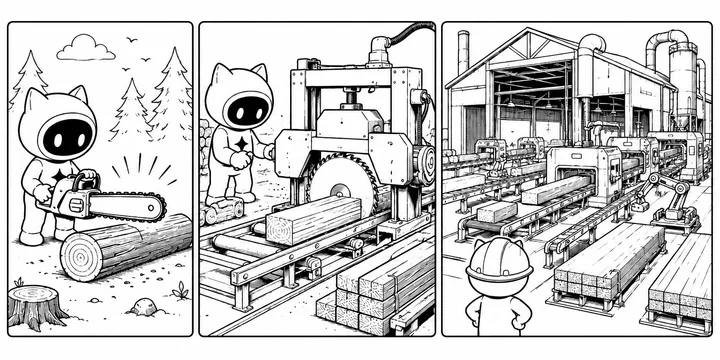
A different framing is often more useful: agents are power tools.
A chainsaw is powerful, fast, and capable of cutting through difficult material. It is also dangerous when used carelessly. The point isn’t to fear the chainsaw or to pretend it’s a person. The point is to respect what it can do, understand where it can fail, and use the right safeguards for the job.
Agentic systems are similar. They are force multipliers. They can move quickly through ambiguity, produce meaningful output, and unlock workflows that were previously too expensive to automate. They can also make costly mistakes when boundaries, supervision, and process design are weak.
Agentic Workflows are machine tools
If agents are power tools, then Agentic Workflows are machine tools.
Think of a stationary saw in a mill: guided, repeatable, and built for controlled precision. You define setup, constraints, and motion. The system executes reliably within those parameters.
That’s the right mental model for production use. We don’t just want raw capability; we want capability that is legible, governable, and repeatable.
Agentic human processes are production lines
At the next level up, agentic human processes look like production lines.
Artifacts move from one tool to another. Some steps are fully automated. Some are semi-automated. Some are supervised by people who set goals, review outcomes, and decide when to intervene.
The value isn’t any single machine. The value comes from orchestration: the careful sequencing of tools, checks, and handoffs that produces high-quality outcomes over time.
Why this matters
If we treat agents like people, we tend to optimize for personality and intuition. If we treat agents like power tools inside machine-tool workflows and production-line processes, we optimize for safety, precision, and throughput.
That shift helps teams make better decisions: where to automate, where to constrain, where to review, and where to keep humans in the loop.
Agents are powerful. That’s exactly why the process around them matters.
Acknowledgement: This story was written with the help of GitHub Copilot.