


The application of AI-enriched automation to software collaboration will soon be as seamless, multi-faceted and ubiquitous as Continuous Integration and Continuous Deployment (CI/CD) are today. We call this new frontier Continuous AI.
What is Continuous AI?
Continuous AI is a label we’ve identified for all uses of automated AI to support software collaboration on any platform. Any use of automated AI to support any software collaboration on any platform anywhere is Continuous AI.
We’ve chosen the term “Continuous AI” to align with the established concept of Continuous Integration/Continuous Deployment (CI/CD). Just as CI/CD transformed software development by automating integration and deployment, Continuous AI covers the ways in which AI can be used to automate and enhance collaboration workflows.
“Continuous AI” is not a term GitHub owns, nor a technology GitHub builds: it’s a term we use to focus our minds, and which we’re introducing to the industry. This means Continuous AI is an open-ended set of activities, workloads, examples, recipes, technologies and capabilities; a category, rather than any single tool.
Some examples of Continuous AI
Some Continuous AI happens today in the industry, and more is appearing all the time. Some examples of Continuous AI we’re seeing include:
-
Continuous Documentation: Continually populate and update documentation, offering suggestions for improvements.
-
Continuous Code Improvement: Incrementally improve code comments, tests and other aspects of code e.g. ensuring code comments are up-to-date and relevant.
-
Continuous Triage: Label, summarize, and respond to issues using natural language.
-
Continuous Summarization: Provide up-to-date summarization of content and recent events in the software projects.
-
Continuous Fault Analysis: Watch for failed CI runs and offer explanations of them with contextual insights.
-
Continuous Quality: Using LLMs to automatically analyze code quality, suggest improvements, and ensure adherence to coding standards.
-
Continuous Team Motivation: Turn PRs and other team activity into poetry, zines, podcasts; provide nudges, or celebrate team achievements.
-
Continuous Accessibility: Automatically check and improve the accessibility of code and documentation.
These tasks have characteristics in common:
-
They are automatable: They can be performed by AI with a high degree of reliability and accuracy.
-
They are repetitive: They involve ongoing tasks that benefit from automation, such as updating documentation or managing issues.
-
They are collaborative: They enhance team workflows and improve the overall software development process.
-
They are integrated: They can be seamlessly integrated into existing workflows and platforms, such as GitHub.
-
They are auditable: They can be monitored and controlled by teams and organizations, ensuring transparency, accountability and utility.
-
There are many variants: There are many different ways to implement these tasks, depending on the specific needs of the team or organization.
-
They are event-triggered: They can be triggered by events in the software development process, such as code changes, issue creation, or pull requests, and care must be taken to balance rate of triggering with other goals.
AI for collaboration, not just individual productivity
Continuous AI is about using AI to enhance collaboration in software projects, not just individual productivity. It focuses on automating tasks that benefit teams, such as documentation, code quality, issue management, and team motivation. The goal is to create a more efficient and enjoyable collaborative environment.
Individual productivity is important, but team productivity introduces new opportunities and considerations. For example, AI code generation by individuals can shift burdens to other team members, or to later stages in software projects. Continuous AI is thus partly about the collective impact of AI on software projects.
Teams and organisations must be in control of the Continuous AI they use: the models and automations used, how they are invoked, and how they integrate with their workflows.
Continuous AI and GitHub
On GitHub today, Continuous AI is supported in initial form by the combination of GitHub Actions and GitHub Models. The synergy between these features is at the core of Continuous AI at GitHub.
These two features can be used in combination with LLM programming frameworks such as GenAIScript, llm or ell. Simple Continuous AI tasks can be built using workflows alone using the ai-inference action alone, and the gh models CLI extension is useful for interacting with Models. Together these tools allow developers to create automated workflows that leverage LLMs for tasks like code generation, documentation, and issue management.
In CI/CD, GitHub empowers our customers through GitHub Actions. We expect the same to be true for Continuous AI. Like CI/CD, most Continuous AI technologies will be 3rd party OSS tools and actions. The broader GitHub and OSS communities are a crucial part of Continuous AI at GitHub. Certain capabilities and features of GitHub will support Continuous AI, and GitHub will improve these capabilities over time. Some existing capabilities of the GitHub platform relevant to Continuous AI include integrated authentication, access control, secrets, security scanning, model evals, code search, semantic indexing and code scanning.
We expect Continuous AI to be a story that runs for 30+ years at GitHub, just like CI/CD.
To explore Continuous AI on GitHub today, we have developed a partner project, GitHub Agentic Workflows, which provides a powerful way to create agentic Continuous AI workflows using natural language.
Explore the docs and examples for GitHub Agentic Workflows at github.com/githubnext/gh-aw
How does Continuous AI relate to agents?
One vision for Continuous AI at GitHub is that the GitHub platform can be a good “home” for software agents - that is, for all agent-like things whose main interaction is with software repos and collaboration.
Continuous AI can involve fully autonomous AI agents, but more often centres on scripted “agent-like” AI workflows. Often these workflows are not fully autonomous, but rather involve human oversight and control. They tend to make targeted, reliable use of AI to automate specific tasks in software collaboration, rather than creating fully autonomous agents that operate arbitrarily.
What is the Continuous AI project at GitHub Next?
The Continuous AI project at GitHub Next is about
-
Introducing the term to the industry.
-
Giving it some meaning by examples, design principles and patterns.
-
Exploring some of what can already be done today on GitHub.
-
Identifying new and existing platform capabilities, opportunities and alignments.
-
Exploring what it means for agents to have their “home” on GitHub.
-
Identifying existing open source Continuous AI technologies in the industry.
-
Nudging existing Continuous AI technologies towards GitHub Models and Actions.
-
Identifying possible Horizon 2 and 3 manifestations of Continuous AI.
Additionally we are collaborating with Microsoft Research on GenAIScript, to improve its capabilities for Continuous AI on GitHub, and using it to deliver some of our Continuous AI examples.
Continuous AI has much in common with nascent industry terms such as “AI Engineering Productivity” and “Augmented Engineering” and we are watching closely what other teams in industry are contributing to this space.
Going fully agentic
A very powerful approach to Continuous AI is through fully or partially “agentic” workflows. Our project GitHub Agentic Workflows provides a powerful way to create agentic Continuous AI workflows using natural language. The example workflows at The Agentics include a variety of Continuous AI examples, including Continuous Documentation, Continuous Triage, Continuous Test Improvement and Contiuous Performance Improvement.
Playing with Continuous AI today
Continuous AI is a broad, long-term agenda and will have many manifestations. To play with some Continuous AI on GitHub today, a very simple way is to use actions/ai-inference from a GitHub Actions workflow in your favourite repository.
You can also use the llm framework in combination with the llm-github-models extension to create LLM-powered GitHub Actions which use GitHub Models using Unix shell scripting.
Some Continuous AI workflows will need more complex programming. One approach is to start with the GenAIScript framework, and use it to create GitHub Actions. GenAIScript provides a way to create and run AI-powered scripts that can automate various tasks in your GitHub repositories. Some specific examples of Continuous AI are included in the samples. See also GitHub Actions with GenAIScript reference material.
Actions programmed with any of the above techniques can be packaged into GitHub Actions and shared with the community. One example of doing this with GenAIScript is this issue labeller which implemented a very simple form of Continuous Triage, using GitHub Models to label issues based on their content via GenAIScript.
Watch this space and the GitHub blogs for more details!
Update We have now published GitHub Agentic Workflows which provide a powerful way to create Continuous AI workflows using natural language.
Related Posts
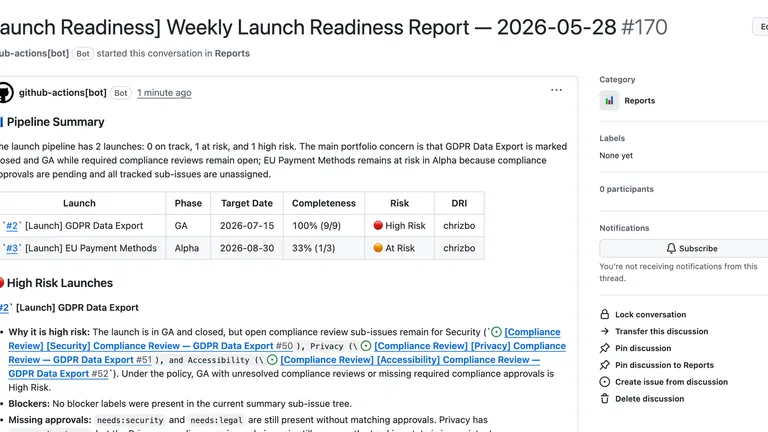

Agentics Beyond Code
What happens when you give PMs, compliance teams, and leaders their own agents? A tour of Agentics Beyond Code — an open-source set of GitHub Agentic Workflows for the non-engineering roles that ship, govern, and operate products.

The Impact of Automated Repository Maintenance Assistance
https://github.com/githubnext/repo-assist-impact/blob/main/report.md
What happens when a proactive AI repository agent is deployed across 13 open source repositories? 578 issues closed, median 8x increase in issue closure velocity, and 10x in PR merge velocity — transforming largely dormant projects into actively maintained ones. The single most important factor? The rate at which human maintainers decide to act.
Understanding Repositories as Human/Agent Knowledge Factories
https://dsyme.net/2026/05/05/understanding-repositories-as-human-agent-knowledge-factories-%f0%9f%9a%80/
How do you maintain team velocity when AI-generated code needs cleanup? You have two choices: slow everyone down with more review hurdles, or let automated agentic processes clean things up after the fact. The second path is the key to velocity — and it’s now practical with repository automation.
Lean Squad: Exploring Automated Software Verification with Near-Zero Human Labour
https://dsyme.net/2026/04/20/lean-squad-automated-software-verification-with-near-zero-human-labour/
What if formal verification could be fully automated — from researching the codebase, to writing specifications, to proving theorems in Lean 4 — all with near-zero human involvement? Lean Squad is a GitHub Agentic Workflow that does exactly this. Applied to three real-world codebases, it produced over 1,200 machine-checked theorems and found real bugs in a drone autopilot.
Start Your Day With Code That’s Better
https://dsyme.net/2026/03/08/start-your-day-with-code-thats-better/
What if you woke up every morning to find your repositories a little bit better than when you left them? A performance improvement here, a feature analysis there, an engineering upgrade you didn’t know was possible. That’s what automated repository maintenance with Repo Assist looks like in practice.
Adding Weighted Task Selection to a GitHub Agentic Workflow
https://dsyme.net/2026/03/07/adding-weighted-task-selection-to-a-github-agentic-workflow/
How should an automated repository assistant decide what to work on next? Round-robin treats every task as equally important regardless of repo state. A weighted approach means the agent now does the right thing more often: when there’s a mountain of unlabelled issues it labels, when the backlog is clear it invests in engineering.
Repo Assist: Crunching the Technical Debt with GitHub Agentic Workflows
https://dsyme.net/2026/02/25/repo-assist-a-repository-assistant/
Can automated repository assistants help maintainers re-engage with stale repositories weighed down by years of technical debt? Repo Assist uses GitHub Agentic Workflows to label issues, answer questions, propose fixes, and make engineering improvements — all while the maintainer stays in control through pull request review.
Automate repository tasks with GitHub Agentic Workflows
https://github.blog/ai-and-ml/automate-repository-tasks-with-github-agentic-workflows/
Coding agents bring new, magical powers to repository automation — and we believe developers, teams and communities should be empowered to shape their use according to their own needs, goals and responsibilities. Our new post on the GitHub Blog introduces GitHub Agentic Workflows as a third leg to augment CI/CD: Continuous AI.
Generative AI and Changing Inputs
https://dsyme.net/2026/01/27/generative-ai-and-changing-inputs/
Every AI feature that generates documentation, synthesizes specifications, or discovers build rules must deal with changing inputs. But when things change, competing goals emerge: freshness, stability, convergence, performance. How do we build incremental AI functions that balance these tradeoffs?
Towards Semi-automatic Agentic Performance Engineering
https://dsyme.net/2025/10/12/towards-semi-automatic-performance-engineering/
Performance engineering is stunningly hard and heterogeneous — every major piece of software is a cornucopia of delight and a vast swamp of complexity. What if coding agents could walk up to arbitrary software repositories and perform realistic, useful performance work? Sometimes it works. Sometimes it’s delusional. But the impossible is gradually revealing itself to be just partially tractable.
Intent, meet Toolchain
https://dsyme.net/2025/09/24/on-specifications-software-and-tools/
From SpecLang to Copilot Workspace to today’s app-dev toolchains — all share a common structure: Intent goes in, elaboration happens, and actuality comes out. But how do these toolchains handle change? And is the 30-year supremacy of “Code is King” really breaking down?
What Kind of Programming is Natural Language Programming?
https://dsyme.net/2025/09/02/what-kind-of-programming-is-natural-language-programming/
Natural language programming is more akin to constraint programming than to traditional precise programming. What we call ambiguity is often genuinely useful generality — and the art is often in specifying less, not more. So what kinds of natural language programming are viable, and what are the limits?
On Continuous AI for Test Improvement
https://dsyme.net/2025/08/27/on-continuous-test-improvement/
Better testing means better software. Within an hour of trialling the Daily Test Coverage Improver on three of the most popular libraries on the planet, multiple PRs improving test coverage were ready. Can Continuous AI finally help the tech industry pay off 50 years of testing debt?
Introducing “Continuous AI”
https://githubnext.com/projects/continuous-ai/
Just as CI/CD transformed software development by automating integration and deployment, Continuous AI covers the ways in which AI can be used to automate and enhance collaboration workflows. It’s a new project at GitHub Next — a broad category of activities, workloads, and capabilities, rather than any single tool.